

Overview of the Philadelphia Campaign in Chester County
By Jane E. Dorchester, July 2026
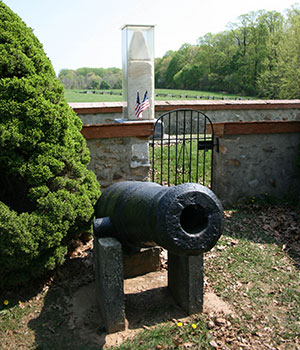
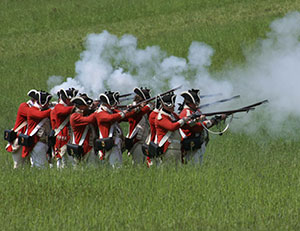
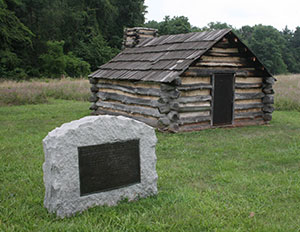
Chester County played a major role in the Philadelphia Campaign of the American Revolution. From one of the largest battles fought to the encampment which proved to be a major turning point in the War, the Campaign occupied Chester County for approximately nine months.
On September 9, 1777, the British entered Chester County after landing at Head of Elk, Maryland on August 25 and engaging in the short battle of Cooch's Bridge in Delaware on September 3. They went on to march to and camp at the village of Kennett Square. Soon after the British arrived, they received word that the Americans had decided to try to stop their advance at Chadds Ford on the Brandywine Creek, so the decision was made to split their forces into two columns in a pincer movement in order to catch the Americans between the arms of the pincer. The British under General Charles Cornwallis were ordered to go north and then east while the Hessians under General Wilhelm von Knyphausen moved due east towards the Brandywine Creek. On September 11, 1777 the two armies clashed. However, because of the pincer movement, the battle actually occurred over a large area of southeastern Chester County and what is now western Delaware County, making the Battle of Brandywine the largest battle to be fought, area wise, in the entire War. Unfortunately, the Battle was a rout for the American Army. The survivors retreated east toward the village of Chester in an effort to evade pursuit by the British on their inexorable march to Philadelphia.
Having successfully retreated from the British at Brandywine, the Americans regrouped and decided to take a stand in the direct path of the advancing British on the South Valley Hill near present-day Frazer. On September 16, 1777, while Washington placed his troops, two separate skirmishes occurred. Soon thereafter, a torrential rain started to fall, soaking soldiers, officers, horses, equipment, and more importantly, gun powder, indiscriminately. Both sides stepped back from the encounter and waited. When it became apparent that the storm would not end very soon, they disengaged. History now knows this encounter as the Battle of the Clouds.
The British continued their march to Philadelphia and camped near Valley Forge in present-day Tredyffrin while Washington marched his troops to Yellow Springs where he split them in two. He sent a small force under General Anthony Wayne east to harass the British and to try to slow down their progress while he led the bulk of the Americans west and north to Chester County's iron country to rest and regroup as well as to protect the iron furnaces and forges that were actively producing cannons and munitions for the war effort.
While Washington was heading to the County's iron country, Wayne and his small force began spying on and harassing the British on their way east. Wayne choose to encamp his men uphill from the Paoli Tavern in what is now Malvern Borough. On the night of September 20, 1777, the British swooped down on Wayne's unsuspecting camp in a surprise midnight raid. To ensure complete tactical surprise, their weapons were only the sword and the bayonet. The unexpectedness and viciousness of the raid led to confusion, panic, and despair. Many of the men, seasoned as they were, fled the scene into the neighboring countryside. Wayne did his best to rally his troops which did make a stand, to little effect: They had been caught completely unaware and unprepared. In a hasty retreat, Wayne got most of his men to safety in as orderly a manner as he could, but valuable equipment and supplies were necessarily left behind. The encounter now known as the Battle of Paoli became the ninth bloodiest battle of the War.
In the meantime, the remaining American force had moved east across the Schuylkill in order to try to stop the British advance on Philadelphia. In spite of their best efforts, the British triumphantly marched into Philadelphia on September 26, 1777. At that point, Washington redirected his troops' efforts to endeavoring to harass the British positions. However, over the next three months they continued to suffer one defeat after another. Finally, in early December, Washington determined to establish his winter camp on a plateau on the west bank of the Schuylkill overlooking Fatland Ford and near Valley Forge.
It has become somewhat of a cliché to describe the American army as it entered its camp on December 19, 1777 as a dispirited ragtag collection of men; however, the description is entirely true. The army had suffered one defeat after another; in Chester County, starting with Brandywine and ending with Paoli, and then continuing with defeats in nearby Philadelphia County, including the British occupation of Philadelphia, with only the aborted Battle of the Clouds to be credited as a draw. In addition, most of the men were literally in rags, were inconsistently armed and undersupplied with food, shoes, blankets, and other necessities. Washington famously wrote "you might have tracked the army . . . to Valley Forge by the blood of their feet." (Book of the Revolution, p. 199) And then, after a long and arduous march, they had had to create a camp and feed themselves with the meager supplies they had at hand.
But unbeknownst to the Americans, hope was on the horizon. First, Washington appointed General Nathanael Greene as Quartermaster General. As quickly and efficiently as he could, Greene reorganized the chain of supplies, enabling a steady, reliable flow of provisions to come into the camp. This meant that, before the camp broke up, the men were better supplied with food, clothes, shoes, and blankets.
Second, several foreign officers showed up at the encampment, among them was Prussian Baron Friedrich von Steuben. Von Steuben established a rigorous "school of the solider" in which he trained the Americans in strict military discipline and tactical maneuvering. The men were disciplined to fight together as a whole unit, regardless of where their leaders had come from.
On June 20, 1778, the American Army marched out of their encampment at Valley Forge. While they had marched in as a ragtag collection of disparate militiamen, they marched out as a united, professional army. They still had a long way to go before they won the United States of America her freedom, but from now on, they would be able to meet the British forces on their own ground and their own terms.
Author's Note
I would like to thank Jim Christ, President of the Paoli Battlefield Preservation Fund and member of the America250 Pennsylvania Chester County Commission, Cliff Parker, Director of the Chester County Archives, and Randell Spackman, reenactor and member of the America250 Pennsylvania Chester County Commission, for their invaluable help in keeping my facts straight!
Sources & Further Reading
- Chester County Planning Commission. Battle of the Clouds Technical Report. West Chester, PA: Chester County Planning Commission, 2013.
- Chester County Planning Commission. Battle of Paoli Technical Report. West Chester, PA: Chester County Planning Commission, 2013.
- Chester County Planning Commission. Brandywine Battlefield Preservation Plan. West Chester, PA: Chester County Planning Commission, 2013.
- Harris, Michael C. Brandywine: A Military History of the Battle that Lost Philadelphia but Saved America, September 11, 1777. El Dorado Hills, CA: Savas Beatie, 2014.
- Lancaster, Bruce and J. H. Plumb. The American Heritage Book of the Revolution. New York: Dell Publishing, 1958.
- McGuire, Thomas J. Battle of Paoli. Mechanicsburg, Pa.: Stackpole Books, 2000.
- McGuire, Thomas J. The Philadelphia Campaign. vol. 1, Brandywine and the Fall of Philadelphia. Mechanicsburg, Pa.: Stackpole Books, 2006.
- Mowday, Bruce E. September 11, 1777 Washington's Defeat at Brandywine Dooms Philadelphia. Shippensburg, Pa.: White Mane Books, 2002.
- Ward, Geoffrey C. The American Revolution: An Intimate History. Based on a documentary film by Ken Burns, Sarah Borstein, and David Schmidt. New York: Alfred A. Knopf, 2025.
About Jane E. Dorchester
Jane E. Dorchester, architectural and local historian, historic preservationist, lecturer, researcher, editor, and writer has been working in the preservation field since 1983. In 2001, Jane received her Master of Science in Historic Preservation from the University of Pennsylvania, concentrating in architectural history and historic preservation administration. Over the past 42+ years, she has researched the histories of a multitude of properties and conducted various historic preservation projects for a variety of clients. In addition, she has been an editor, writer, and lecturer. She has twice been the editor, including being the founding editor, of the Chester County Ledger and has copied-edited numerous reports and articles. She has lectured on and written about a wide variety of history oriented topics from "How to Research Your Historic Property" to "What is Serpentine". Her articles have appeared in the Chester County Day Paper, the Chester County Historical Society Antiques Show Catalogue, the Chester County Ledger, County Lines, and the Daily Local News. She is currently Proprietor of Jane E. Dorchester, Architectural Historian, a historic preservation consulting firm located in East Goshen Township, Pennsylvania.